
- Clear Signing displays human-readable transaction details on your hardware wallet screen before approval
- Transaction Check uses machine learning to flag suspicious transactions and known scam contracts in real time
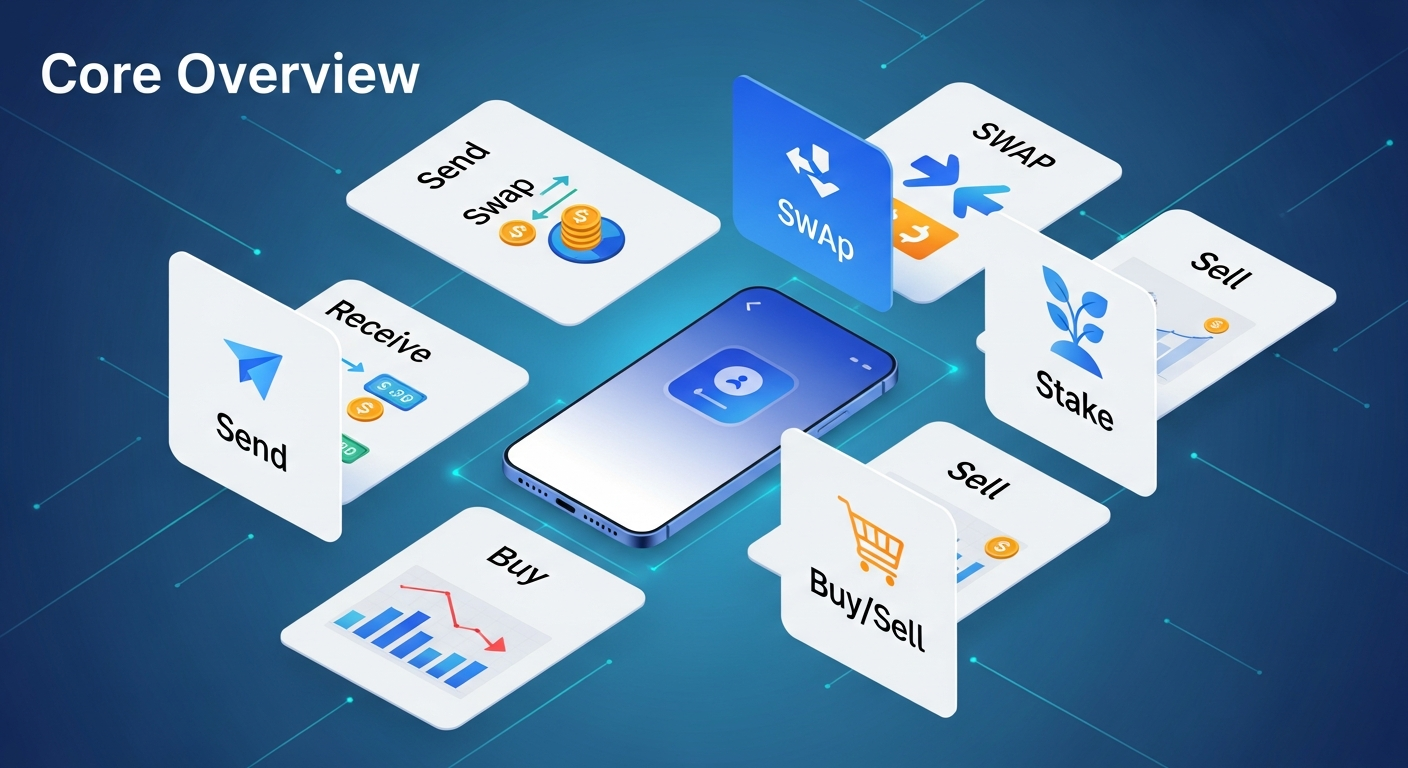
- Integrated buy, sell, and swap with rate comparison across multiple providers including Changelly, 1inch, and MoonPay
- Native staking for ETH, SOL, DOT, ATOM, and other proof-of-stake assets with reward tracking
- NFT gallery for viewing, organizing, and transferring digital collectibles across multiple blockchains
- Multi-chain portfolio supporting 5,500+ assets across Bitcoin, Ethereum, Solana, and dozens more networks
- DeFi dApp browser for accessing decentralized applications with hardware wallet transaction signing
- Ledger Recover optional encrypted seed phrase backup for peace of mind
Ledger Wallet combines the impenetrable security of hardware wallet signing with a rich feature set that covers every aspect of cryptocurrency management. From the moment you pair your Ledger device, every feature described below operates under the protection of your Secure Element chip — ensuring that no transaction can execute without your explicit physical confirmation. Ready to get started? Follow our step-by-step setup guide.
Clear Signing
Clear Signing is Ledger’s signature security innovation that transforms how users verify transactions before approving them. Traditional hardware wallets display raw hexadecimal transaction data on their screens — essentially asking users to approve something they cannot meaningfully read or understand. This “blind signing” problem has been exploited repeatedly by attackers who craft malicious transactions disguised as legitimate approvals.
With Clear Signing, Ledger Wallet parses transaction data and displays it in plain, human-readable language directly on your hardware wallet’s trusted screen. When you initiate a token transfer, your device shows the exact recipient address, the precise amount being sent, the network fee, and the blockchain network. For smart contract interactions, Clear Signing decodes the contract call to show you the specific action being performed — whether it is a token swap, a staking delegation, an NFT transfer, or a DeFi approval.
This transparency eliminates an entire category of attack vectors. Phishing sites that trick users into signing malicious approvals become ineffective because the hardware wallet screen reveals the true nature of the transaction. Clear Signing is available for an expanding list of dApps and protocols, with Ledger actively working with projects across the ecosystem to integrate transaction parsing for their smart contracts.
Transaction Check (ML-Powered)
Transaction Check is Ledger’s machine-learning security layer that analyzes every transaction before it reaches your hardware wallet for signing. The system evaluates transactions against a continuously updated database of known scam addresses, malicious smart contracts, and suspicious behavioral patterns, providing an instant risk assessment that warns you about potential threats.
When you initiate a transaction in Ledger Wallet, Transaction Check performs multiple analyses in parallel: it verifies the recipient address against blacklists of known scam wallets, checks the smart contract code for dangerous functions like unlimited token approvals or hidden transfer mechanisms, evaluates the transaction context for common attack patterns such as address poisoning or approval hijacking, and cross-references the dApp or protocol with community-reported security incidents.
The result is displayed as a clear risk indicator before you confirm on your device — green for verified safe transactions, yellow for transactions requiring additional review, and red for transactions flagged as high-risk or matching known scam patterns. Transaction Check does not prevent you from proceeding with any transaction; it provides information to help you make an informed decision, respecting your sovereignty while adding an intelligent protection layer.
Buy, Sell & Swap
Ledger Wallet integrates multiple third-party providers directly into the application, allowing you to buy cryptocurrency with fiat currency, sell crypto back to fiat, and swap between different tokens — all without leaving the secure Ledger ecosystem. Purchased assets are delivered directly to your hardware wallet address, and every swap transaction requires physical confirmation on your Ledger device.
For buying crypto, integrated partners include MoonPay, Ramp, Sardine, and Banxa, supporting payment methods such as credit and debit cards, bank transfers, Apple Pay, and Google Pay depending on your region. For swapping, Ledger Wallet aggregates rates from Changelly, 1inch, Paraswap, and other decentralized exchange aggregators, displaying a side-by-side comparison so you can select the best rate for every trade.
The swap comparison feature is particularly valuable because rates and fees vary significantly between providers depending on the token pair, trade size, and current market conditions. By presenting multiple quotes simultaneously, Ledger Wallet ensures you always get competitive pricing without needing to manually check each provider separately.
Staking (ETH, SOL, DOT, ATOM)
Earn passive income on your crypto holdings by staking directly through Ledger Wallet. The application provides integrated staking for multiple proof-of-stake networks including Ethereum (ETH), Solana (SOL), Polkadot (DOT), Cosmos (ATOM), Tezos (XTZ), and others. Staked assets remain under your control in your hardware wallet — you delegate voting power to validators but never transfer custody of your tokens.
For Ethereum staking, Ledger Wallet partners with staking providers like Lido and Kiln, allowing you to stake any amount of ETH (no 32 ETH minimum required for pooled staking). You receive liquid staking tokens (such as stETH) that represent your staked position and continue to accrue rewards while remaining tradable and usable in DeFi protocols.
The staking dashboard displays your current staked amounts, accumulated rewards, annualized percentage yield (APY), and validator performance metrics. Reward tracking is automatic, with historical earnings charts that help you monitor your passive income over time. All staking and unstaking operations require confirmation on your hardware wallet, ensuring complete security throughout the process.
NFT Gallery
Ledger Wallet includes a dedicated NFT gallery that lets you view, organize, and manage your digital collectible collection directly within the application. The gallery automatically detects and displays NFTs held in your connected accounts across Ethereum, Polygon, and other supported networks, rendering full-resolution images, animations, and metadata for each piece.
You can browse your collection by network, contract, or collection, and view detailed information about each NFT including its name, description, traits, creator, and transaction history. Sending NFTs to other addresses is fully supported with the same hardware wallet signing security that protects all other transactions — you verify the recipient address and the specific NFT being transferred on your device screen before confirming.
The gallery also provides visibility into NFTs that you may not have requested, such as airdropped tokens or spam NFTs. This awareness helps you identify unsolicited NFTs that could be part of social engineering attacks, where scammers send NFTs containing phishing links or malicious metadata to trick recipients into visiting compromised websites.
Multi-Chain Portfolio
Ledger Wallet supports over 5,500 digital assets across dozens of blockchain networks, providing a unified portfolio view that aggregates all your holdings into a single dashboard. Supported networks include Bitcoin, Ethereum, Solana, Polkadot, Cosmos, Cardano, Avalanche, Arbitrum, Optimism, Polygon, BNB Chain, Tron, Stellar, Algorand, and many more.
Each blockchain account is managed as a separate entry within Ledger Wallet, with dedicated send, receive, and transaction history views. The portfolio overview aggregates all accounts to display your total portfolio value in your preferred fiat currency, along with 24-hour, 7-day, and 30-day performance metrics, asset allocation charts, and individual position details.
Adding new blockchain accounts is straightforward — select the network, install the corresponding app on your Ledger device if not already present, and Ledger Wallet automatically derives the appropriate addresses from your seed phrase. This process supports multiple accounts per network, allowing you to organize your holdings by purpose (trading, savings, DeFi, etc.) while maintaining a complete portfolio overview.
DeFi dApp Browser
Access the decentralized finance ecosystem directly from Ledger Wallet through the integrated dApp browser and Web3 connection capabilities. Connect to popular DeFi protocols including Uniswap, Aave, Lido, Curve, Compound, and dozens more, with every transaction secured by your hardware wallet.
The dApp browser functions as a secure portal between your Ledger device and decentralized applications. When a dApp requests a transaction signature, Ledger Wallet routes the signing request to your hardware wallet, where Clear Signing displays the transaction details for your review. This ensures that even when interacting with complex smart contracts, you maintain full visibility and control over what you are approving.
Ledger Wallet also supports WalletConnect, enabling you to connect your hardware wallet to mobile dApps and web-based protocols that support the WalletConnect standard. This extends the reach of your hardware wallet security to virtually any decentralized application in the ecosystem, regardless of whether it has a native Ledger integration.
Ledger Recover
Ledger Recover is an optional subscription service that provides encrypted backup of your recovery phrase for users who want an additional safety net beyond the traditional paper backup approach. The service splits your seed phrase into three encrypted fragments using Shamir’s Secret Sharing, distributing them to three independent, geographically separated custodians. No single custodian holds enough information to reconstruct your seed phrase.
To restore access, you complete an identity verification process and request fragment reassembly, which requires authorization from at least two of the three custodians. The reassembled seed phrase is transmitted directly to a new Ledger device through an encrypted channel, never appearing in plaintext on any screen or server.
Ledger Recover is entirely optional and designed for users who are concerned about losing their physical seed phrase backup. Users who prefer traditional self-custody without third-party involvement can continue managing their own recovery phrase backups as they always have. The service provides a safety net — not a requirement — and does not change how the core Ledger security model works for those who choose not to use it.